Tell us about the job
Takes about a minute. No obligation.
A furnace repair in Washington County starts with the burner assembly and the ignition system, because those are the parts that have been cycling hardest. Homes in Washington County, RI run heat about eight months a year, from October through May. The heat exchanger takes that same load, and a contractor inspecting one here checks it closely for fatigue that builds quietly over repeated heating cycles. Cracks in the exchanger show up as wear, not accident, and a repair scope that skips it misses where the hours have actually gone.
Half the homes in Washington County, Rhode Island were built in 1977 or earlier (2020-2024 ACS 5-year). A furnace that has been running in a house of this vintage may be drawing on parts that manufacturers have phased out or moved to special order. When a contractor opens the unit, what they find drives the job: a common failure on newer equipment means a same-day fix, but the same symptom on an older system can stall on a heat exchanger or a control board that takes days to source. The age of the housing stock is the reason that repair timelines here are decided as much at the parts counter as at the unit itself.
The Parts of a Furnace a Contractor Checks First
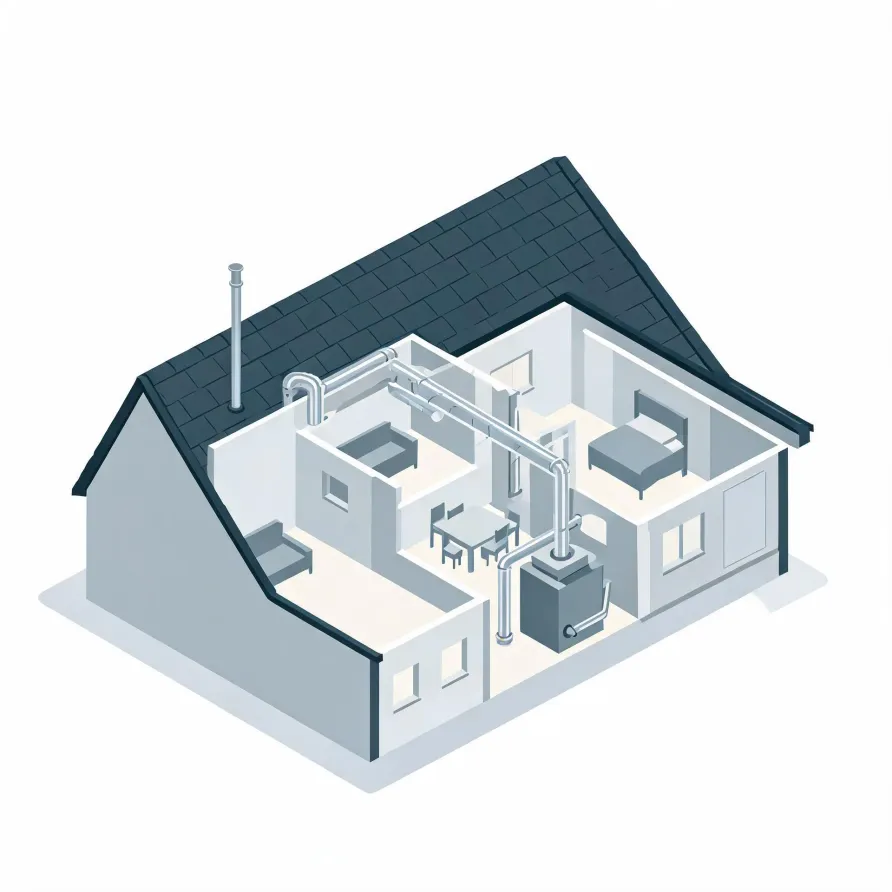
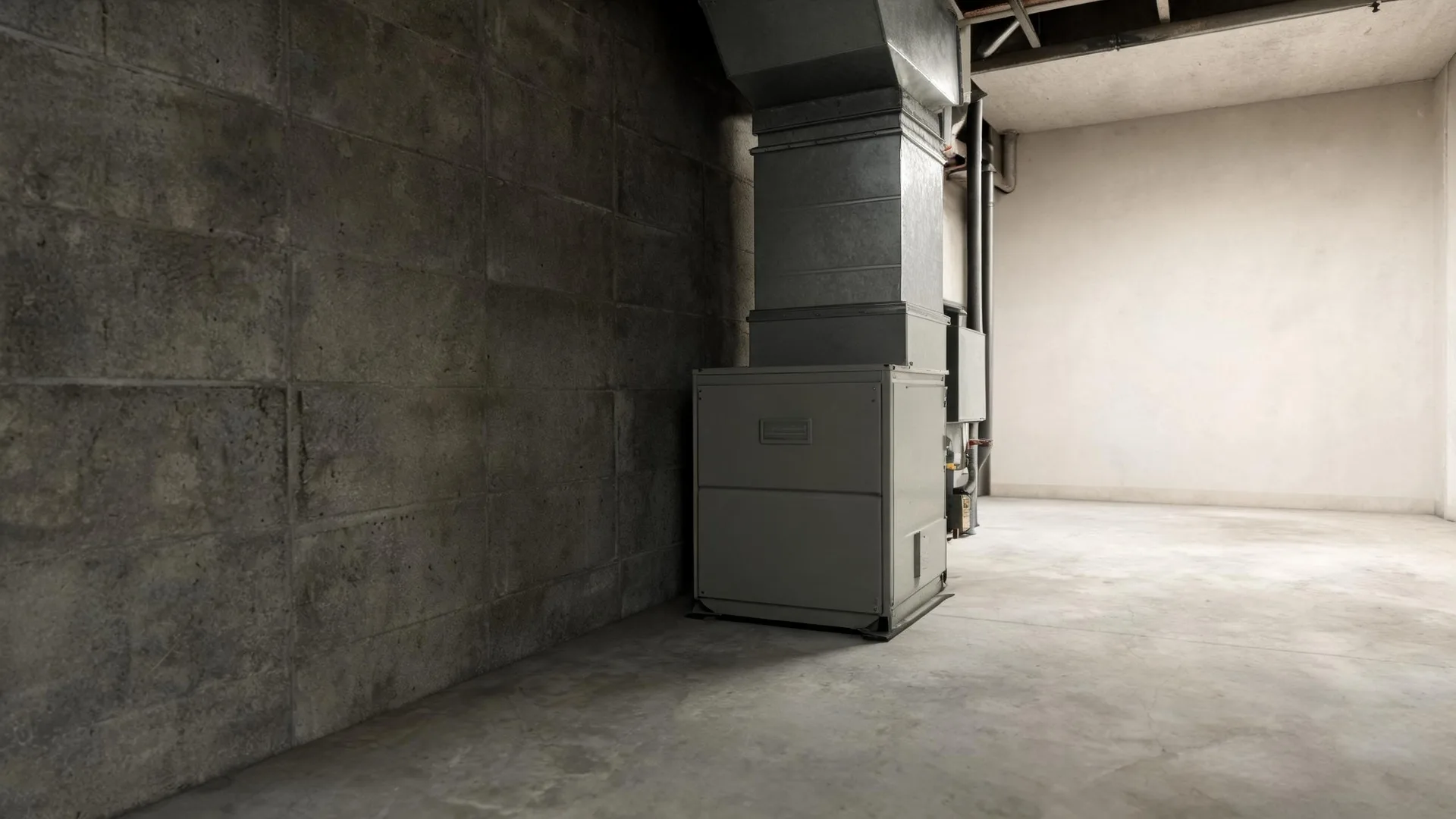
The furnace cabinet sits in a basement, utility room, or closet and holds the components a contractor reaches for first: the heat exchanger, the burner assembly, and the blower motor. A cracked heat exchanger lets combustion gases into living air. A failed burner means no heat at all, and a seized blower motor means warm air stays trapped in the cabinet.
The flue pipe runs from the cabinet up and out of the house, carrying exhaust gases away from the living space. Near the cabinet, the gas valve and igniter work together to start and sustain combustion. The thermostat on a wall inside the house is the first thing a contractor checks when a furnace stops responding, because a wiring or calibration fault there can mimic a deeper failure.
The drawing shows a typical furnace layout, and a licensed contractor determines which components apply to the specific system in your home.
Find a contractor in Washington CountyWashington County by the numbers
166 severe weather events were recorded in Washington County, Rhode Island between 2015 and 2024.
NOAA National Centers for Environmental Information, Storm Events Database, bulk CSV export, events 2015-01-01 through 2024-12-31.Half the homes in Washington County, Rhode Island were built in 1977 or earlier (2020-2024 ACS 5-year).
U.S. Census Bureau, 2020-2024 American Community Survey 5-Year EstimatesWashington County, Rhode Island holds 66,385 housing units (2020-2024 ACS 5-year).
U.S. Census Bureau, 2020-2024 American Community Survey 5-Year EstimatesOwners occupy 77.5% of the occupied homes in Washington County, Rhode Island (2020-2024 ACS 5-year).
U.S. Census Bureau, 2020-2024 American Community Survey 5-Year EstimatesCodes & Licensing That Cover Furnace Repair in Washington County, Rhode Island6 sourced rules and standards
What happens when a contractor comes out to your home
Non-weatherized gas furnaces manufactured on or after November 19, 2015 must reach 80.0 percent AFUE.
Non-weatherized oil-fired furnaces manufactured on or after November 19, 2015 must reach 83.0 percent AFUE.
Mobile home gas furnaces manufactured on or after November 19, 2015 must reach 80.0 percent AFUE.
Non-weatherized gas furnaces manufactured on or after December 18, 2028 must reach 95.0 percent AFUE, up from the 80.0 percent minimum that applies to units manufactured before that date.
Licensing and Legal Requirements in Washington County, Rhode Island
A Rhode Island master licensee needs no separate sheet metal licence while the air handling equipment is ten (10) tons or less, or the heating equipment does not exceed 250,000 BTUs; above either figure the sheet metal work must be subcontracted to a licensed sheet metal contractor.
Rhode Island requires a licence from the Department of Labor and Training to work in the mechanical trades: nobody may hold themselves out as a master, or advertise that they will install refrigeration and air conditioning or air distribution systems, without one.
Weather Stress on HVAC Equipment in Washington County
Heating equipment in Washington County works against whatever the local climate puts on it, and that workload is a direct driver of wear, breakdowns, and repair frequency. How hard the weather pushes here shapes how hard the furnace works, which is why local weather history belongs on a page about furnace repair.
166 severe weather events, 2015–2024. Source: NOAA National Centers for Environmental Information, Storm Events Database.