Tell us about the job
Takes about a minute. No obligation.
A furnace repair in Kent County starts with a contractor establishing what the burner and heat exchanger have actually been through, because those components carry the full load of a long heating season before most faults surface. Homes in Kent County, RI run heat about eight months a year, from October through May. Ignition systems cycle every time the burner fires, and a season that runs from October through May gives the igniter, flame sensor, and heat exchanger little rest between calls. By the time a homeowner notices a problem, wear on those parts is already accumulated. A contractor who prices only the failed component and skips the exchanger inspection is quoting around the costliest risk in the system.
Furnace repair in stock this old runs into a parts problem that newer housing rarely faces. Half the homes in Kent County, Rhode Island were built in 1967 or earlier (2020-2024 ACS 5-year). A system running in a house built around that era may have gone through one or two replacements already, and what a contractor pulls out of a failed furnace today could be a unit whose manufacturer no longer supports it, whose components have to be sourced through specialty distributors rather than standard supply houses, or whose tolerances differ enough from current replacements that the contractor has to verify fit before ordering. That gap between what a house was built for and what runs in it now is where repair jobs get complicated, and where the quote a homeowner receives reflects availability as much as labor.
The Parts of a Furnace a Contractor Checks First
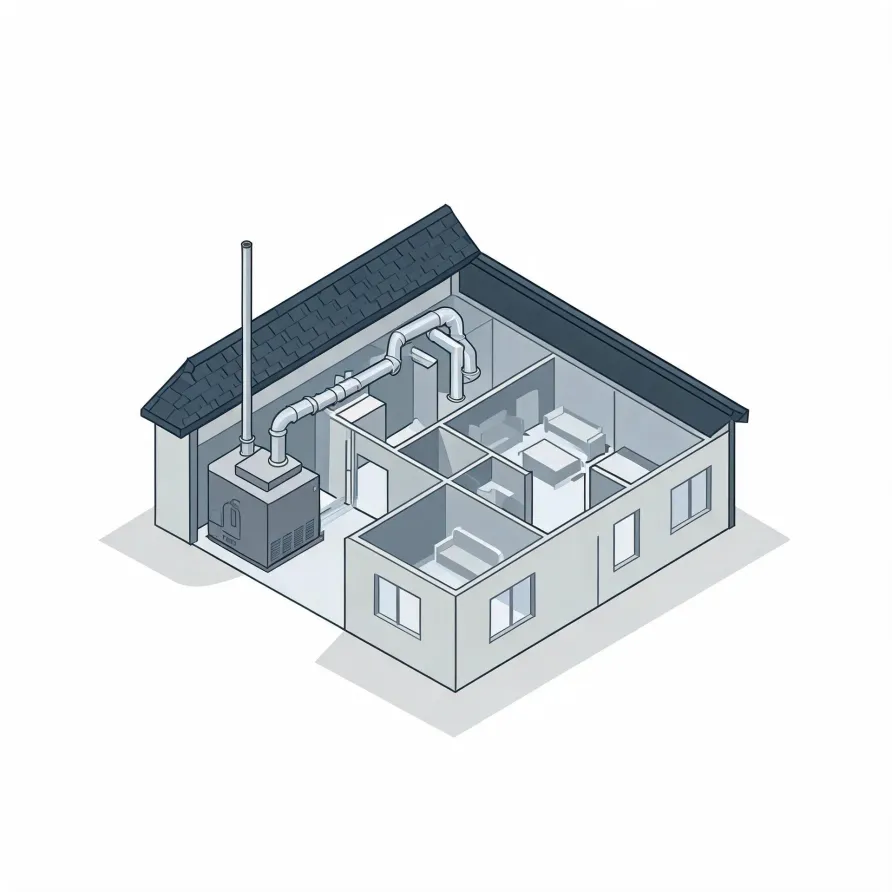
The furnace itself sits in the basement, utility room, or closet and is the piece a contractor goes to first. Inside it, the heat exchanger is the part that fails most quietly and matters most: cracks there let combustion gases into living space. The burners, igniter, and flame sensor all sit within the furnace cabinet and are where most no-heat calls begin.
The blower motor pulls air across the heat exchanger and pushes it through the house. It sits at the base of the furnace cabinet. The flue pipe runs from the top of the furnace to an exterior wall or chimney, and blockages or separations there show up as pressure faults or carbon monoxide readings that stop the unit from running.
The drawing shows a typical furnace layout, and a licensed contractor determines which components apply to your specific system and what each one needs.
Find a contractor in Kent CountyKent County, by the record
146 severe weather events were recorded in Kent County, Rhode Island between 2015 and 2024.
NOAA National Centers for Environmental Information, Storm Events Database, bulk CSV export, events 2015-01-01 through 2024-12-31.Half the homes in Kent County, Rhode Island were built in 1967 or earlier (2020-2024 ACS 5-year).
U.S. Census Bureau, 2020-2024 American Community Survey 5-Year EstimatesKent County, Rhode Island holds 76,529 housing units (2020-2024 ACS 5-year).
U.S. Census Bureau, 2020-2024 American Community Survey 5-Year EstimatesOwners occupy 73.1% of the occupied homes in Kent County, Rhode Island (2020-2024 ACS 5-year).
U.S. Census Bureau, 2020-2024 American Community Survey 5-Year EstimatesCodes & Standards Covering Furnace Repair in Kent County, Rhode Island6 sourced rules and standards
What Happens When a Contractor Shows Up
Non-weatherized gas furnaces manufactured on or after November 19, 2015 must reach 80.0 percent AFUE.
Non-weatherized oil-fired furnaces manufactured on or after November 19, 2015 must reach 83.0 percent AFUE.
Mobile home gas furnaces manufactured on or after November 19, 2015 must reach 80.0 percent AFUE.
Non-weatherized gas furnaces manufactured on or after December 18, 2028 must reach 95.0 percent AFUE, up from the 80.0 percent minimum that applies to units manufactured before that date.
Licensing and Legal Requirements in Kent County, Rhode Island
A Rhode Island master licensee needs no separate sheet metal licence while the air handling equipment is ten (10) tons or less, or the heating equipment does not exceed 250,000 BTUs; above either figure the sheet metal work must be subcontracted to a licensed sheet metal contractor.
Rhode Island requires a licence from the Department of Labor and Training to work in the mechanical trades: nobody may hold themselves out as a master, or advertise that they will install refrigeration and air conditioning or air distribution systems, without one.
Weather Stress on Furnaces in Kent County
Extreme weather events put real hours on heating equipment. Each one is a load spike, a pressure cycle, or a run that does not end, and that kind of use is what wears a furnace down and brings repair calls in Kent County.
146 severe weather events, 2015–2024. Source: NOAA National Centers for Environmental Information, Storm Events Database.